Upselling PCW users

Upselling PCW users

Goal: Getting more value from each customer coming from a comparison website partnership channel.


My role in this project was to make sure the customer’s experience in this journey was kept easy, quick and frictionless while improving our average transaction value (ATV).


Urban Jungle Insurance is an insurtech using technology to challenge an outdated industry. My role was to contribute to building a simple, fair, and affordable product with the best-in-class UX and UI.

Understanding the problem

  1. What did success looked like?

The goal: To improve the average transaction value without hurting conversion. Challenging this channel against our direct journeys and keeping new design easy and quick to develop.

Great UX

Preserve the great experience we were already offering customers

Better ATV

Improving the value per customer while keeping our current conversion rate

The existing product had a great conversion rate! Only a few pages from landing to payment, price transparency and clear summaries of cover.

Great UX

Customers loved that the price they got from the PCW was what they paid

Lower ATV

Compared to the ATV from our direct journeys, this channel was much lower

Competitors in the insurance space with similar journey and channels had longer journeys and got more value per customer.

Bad UX

Overwhelming package pages, scarcity copy no price transparency and long journeys

Better ATV

Competitors were able to get more value per converted customers.

  1. Who were we designing for?

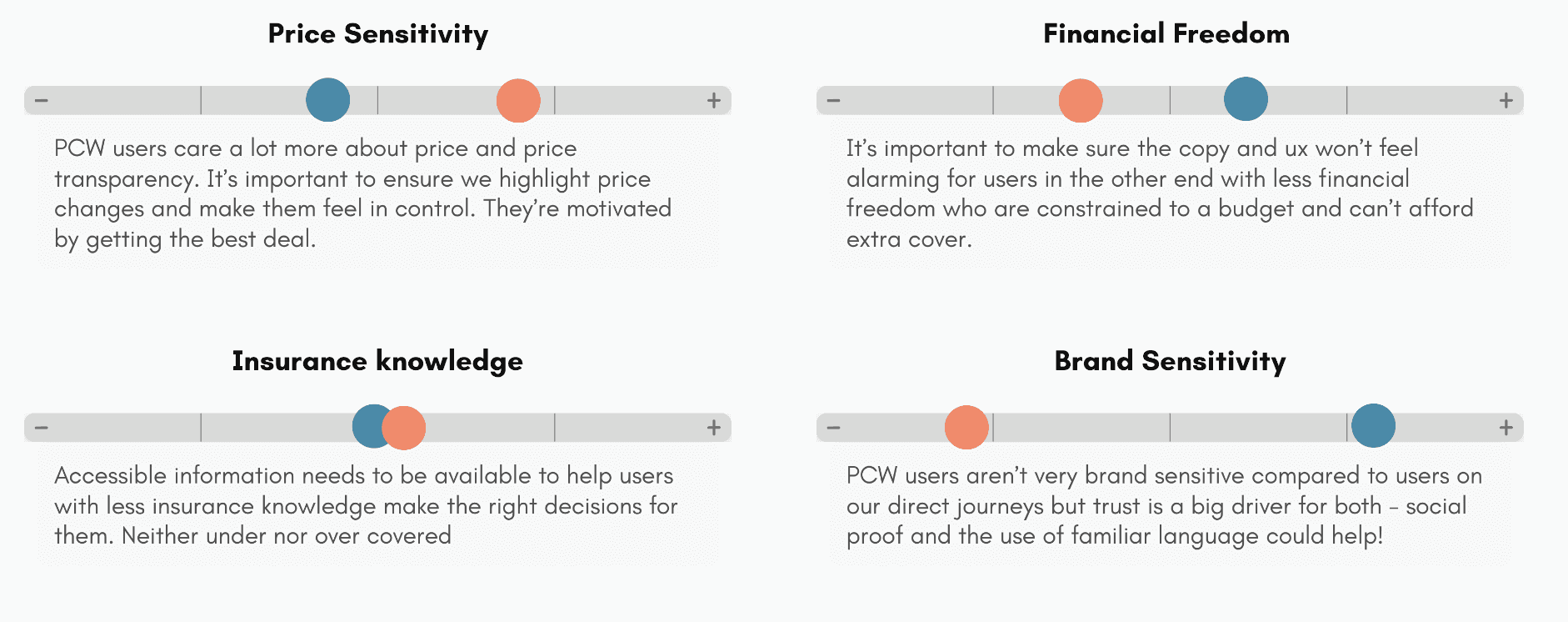
It was helpful to understand the different users we were designing for, their attitudes and what they cared about when getting insurance. To visualise and communicate this, I used the user spectrums I had created to frame the range of Urban Jungle customers. See below where customers from our partnership channels (PCW users) vs direct customers fall:


PCW users care a lot more about price and price transparency. It’s important to ensure we highlight price changes and make them feel in control. They’re motivated by getting the best deal.

Price Sensitivity

It’s important to make sure the copy and ux won’t feel alarming for users in the other end with less financial freedom who are constrained to a budget and can’t afford extra cover.

Financial Freedom

Accessible information needs to be available to help users with less insurance knowledge make the right decisions for them. Neither under nor over covered

Insurance knowledge

PCW users aren’t very brand sensitive compared to users on our direct journeys but trust is a big driver for both - social proof and the use of familiar language could help!

Brand Sensitivity

PCW users care a lot more about price and price transparency. It’s important to ensure we highlight price changes and make them feel in control. They’re motivated by getting the best deal.

PCW users care a lot more about price and price transparency. It’s important to ensure we highlight price changes and make them feel in control. They’re motivated by getting the best deal.

Price Sensitivity

It’s important to make sure the copy and ux won’t feel alarming for users in the other end with less financial freedom who are constrained to a budget and can’t afford extra cover.

It’s important to make sure the copy and ux won’t feel alarming for users in the other end with less financial freedom who are constrained to a budget and can’t afford extra cover.

Financial Freedom

Accessible information needs to be available to help users with less insurance knowledge make the right decisions for them. Neither under nor over covered

Accessible information needs to be available to help users with less insurance knowledge make the right decisions for them. Neither under nor over covered

Insurance knowledge

PCW users aren’t very brand sensitive compared to users on our direct journeys but trust is a big driver for both - social proof and the use of familiar language could help!

PCW users aren’t very brand sensitive compared to users on our direct journeys but trust is a big driver for both - social proof and the use of familiar language could help!

Brand Sensitivity

Exploring solutions

To start putting ideas together, I drew out the current user flow and thought about how and where we could introduce ways to upsell the user.

While creating initial ideas, I continuously shared sketches and Figma files with the project's engineers to get feasibility feedback. These conversations raised technical limitations about where and when we'd be able to show the final price of a add-on and how much we could personalise the add-ons shown eg. Only show pet cover to customers we know have pets.


After discussing these with the PM, we set on 3 ideas to visualise and explore further:

To start putting ideas together, I drew out the current user flow and thought about how and where we could introduce ways to upsell the user.

​While creating initial ideas, I continuously shared sketches and Figma files with the project's engineers to get feasibility feedback. These conversations raised technical limitations about where and when we'd be able to show the final price of a add-on and how much we could personalise the add-ons shown eg. Only show pet cover to customers we know have pets.


After discussing these with the PM, we set on 3 ideas to visualise and explore further:

Add-on cards on the summary page

Keeps the user journey as short as it is

Uses existing components - easy to build

Takes away the main action from this page, goes against our pagination principle

Looks crowded and could increase the user’s cognitive load
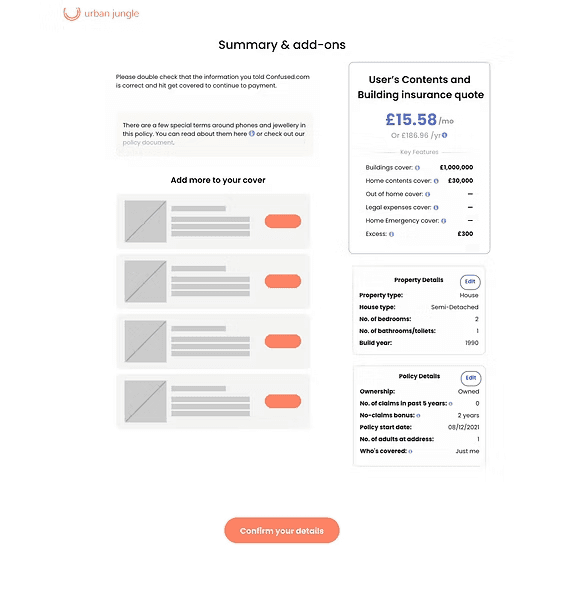
Add more to your cover
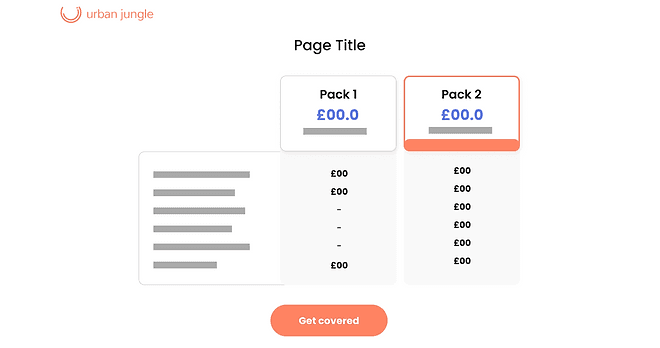
New package page

Users could focus solely on this task and understand the new package

Very similar to competitors - tested and proved

Makes the journey to payment longer

Disregards the package selected on the PCW

Can look and feel overwhelming

Complex design - hard to build

£00.0

Pack 1

£00

£00

-

-

-

£00

£00.0

Pack 2

£00

£00

-

-

-

£00

Pack 2

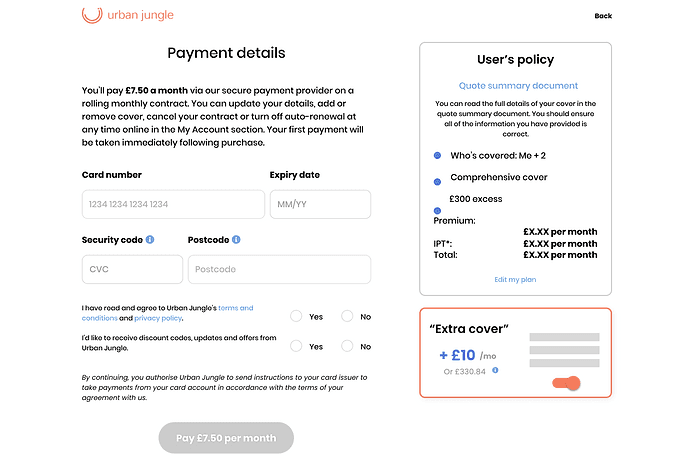
Add-ons on payment page

Keeps the journey short

“Side action” - users can chose not to interact with it

Late stage for the user to add more cover


No space to provide enough context for users to understand the cover

Or £XXX.XX /yr

+ £XX

/mo

“Extra cover”

New package page

Users could focus solely on this task and understand the new package

Very similar to competitors - tested and proved

Makes the journey to payment longer

Disregards the package selected on the PCW

Can look and feel overwhelming

Complex design - hard to build

£00.0

Pack 1

£00

£00

-

-

-

£00

£00.0

Pack 2

£00

£00

-

-

-

£00

Pack 2

Add-ons on payment page

Keeps the journey short

“Side action” - users can chose not to interact with it

Late stage for the user to add more cover


No space to provide enough context for users to understand the cover

Or £XXX.XX /yr

+ £XX

/mo

“Extra cover”

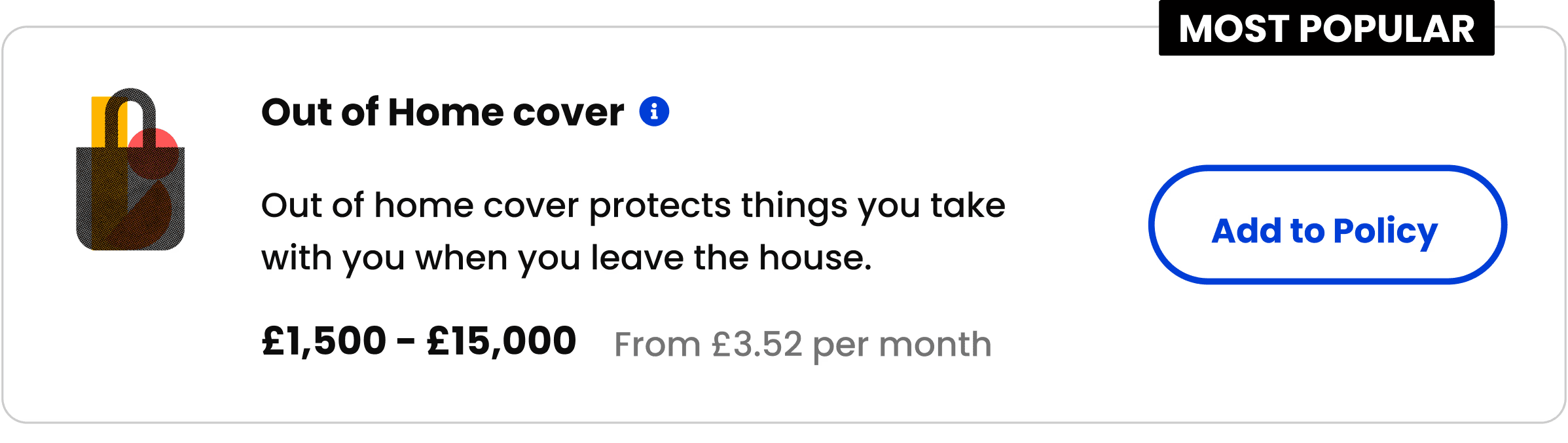
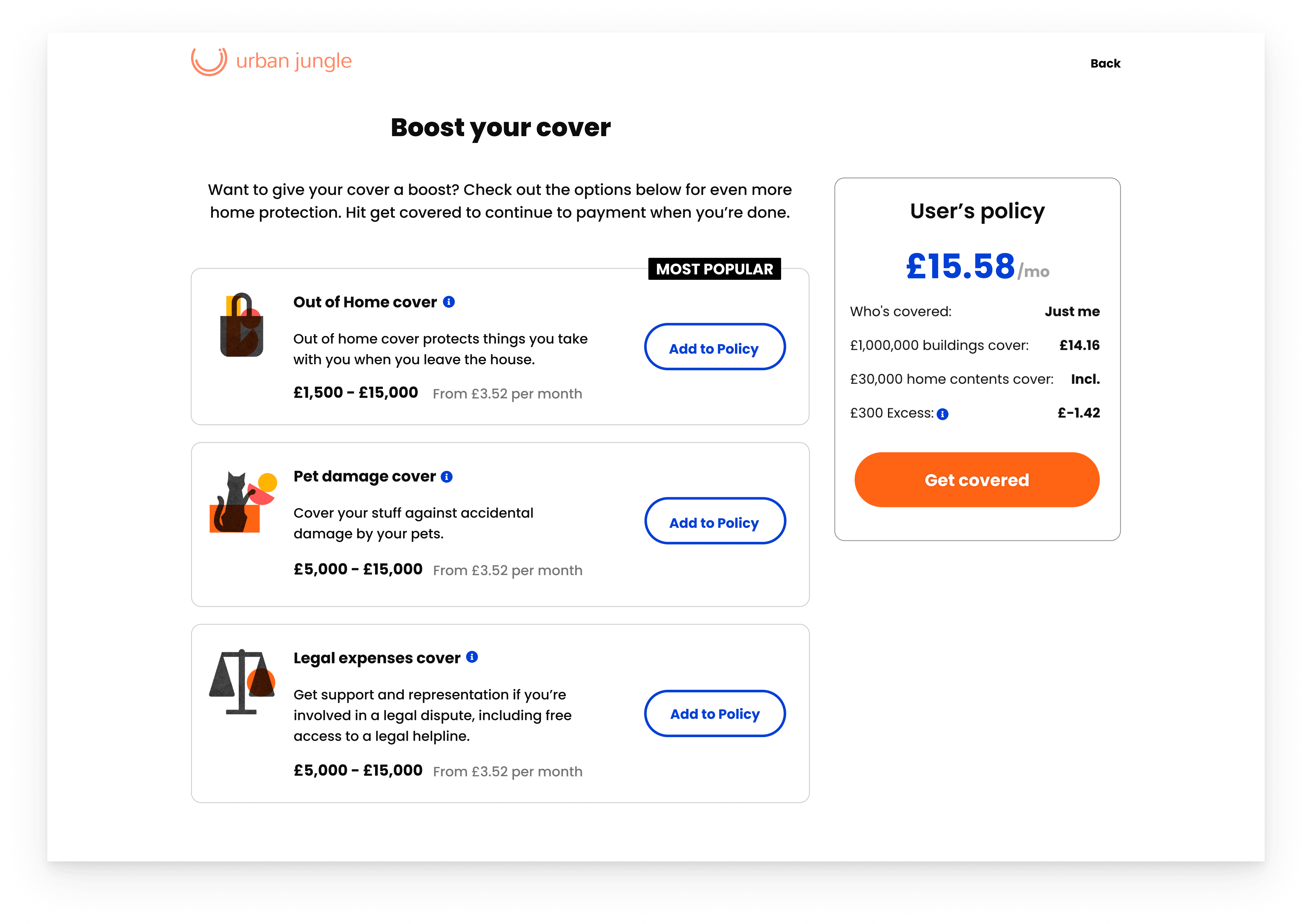
Simple add-on page: Ready for testing

Simple add-on page: Ready for testing

Simple add-on page: Ready for testing

The concept we settled on covered the following:

Doesn't get in the way of other actions

Uses existing components - easy to build

Simple UX tested and proven on our own journey

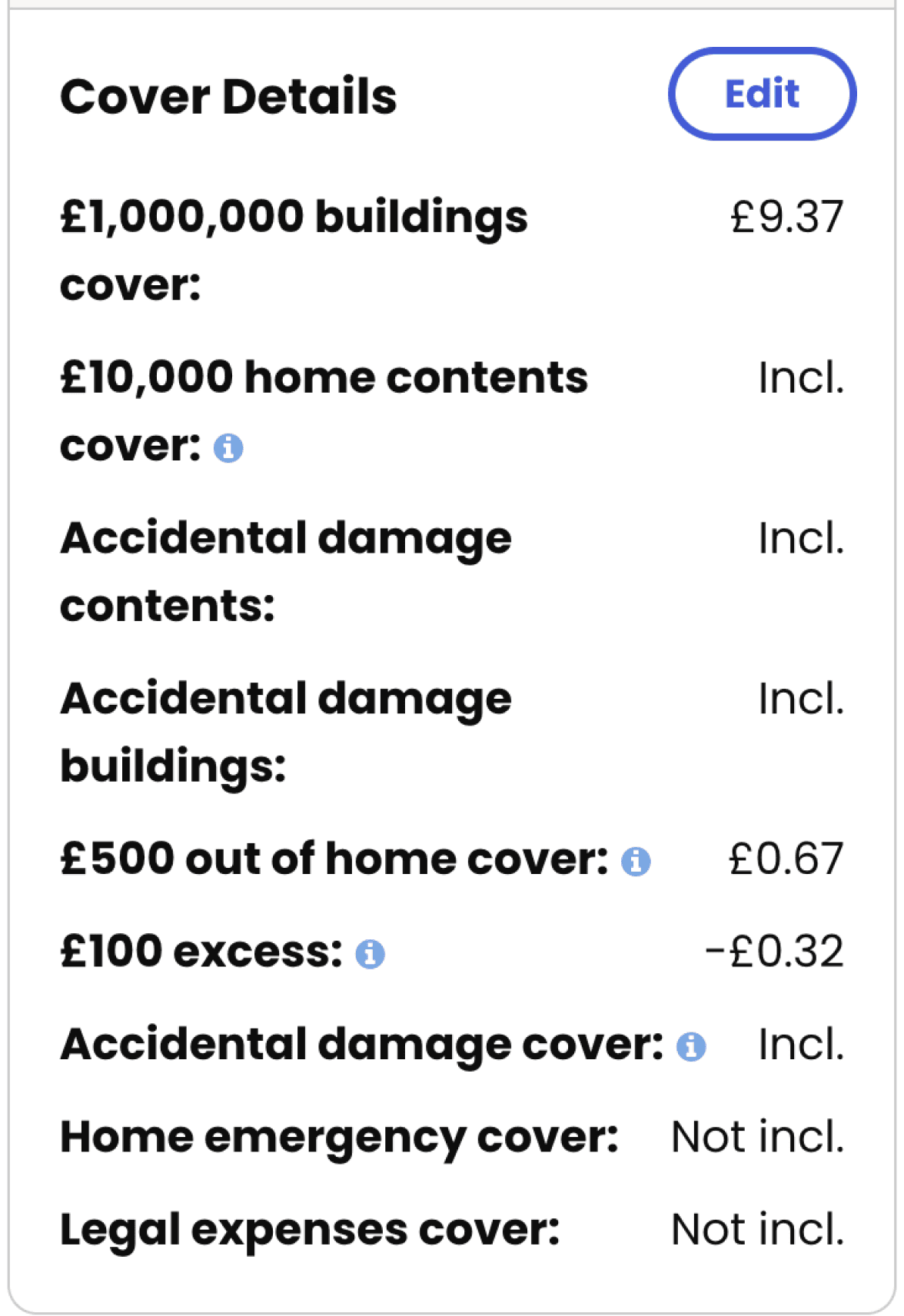
Users can see how the addition affects their price

Unlike competitors we designed with user needs in mind and avoided the following:

Fearful and scarcity copy to make users feel they need to add more cover urgently

Offering a different package form the user selected and expected to buy

Not letting users continue until they interact with add-ons/packages

Real user interaction

Real user interaction

Real user interaction

A/B test results + improvements

After setting up an A/B test function where 50% of users entering the partnership journey saw the additional page (varient A), we found the following from quantitative data:

  • ~15% of users in varient A added more cover to their policy 

  • Average transition value (ATV) was 2.5% higher for users in varient A

  • Conversion stayed the same for the two groups

Hover the image below to see after launch improvements

We also had great qualitative signal, from user interviews where no direct questions about the page were asked:


  • Most users mentioned how quick the journey felt compared to other providers 

  • Some users found and considered add-ons they didn't know about or saw on the PCW

  • Users mentioned finding it useful to be able to add extra cover at that point in the journey

  • No users mention the journey feeling long or overbearing with add-ons ​

We were happy with these findings and expanded the use of the page to other products!
New brand icons and colours

offering a clearer and bolder

visual language

Smarter add-on suggestions

using data for a personalised UX

"Most popular" label

for social proof and guidance

Back to homepage

Lara

Santos

Thanks for having a look!

What next?

Back to homepage

Lara

Santos

Thanks for having a look!

What next?